

TOFU trust ledger
gwm runs the [[bootstrap.*]] pipeline from .gwm.toml under your user: copies, regex guards, no-symlink checks, and arbitrary shell commands. Cloning a repository and running gwm create (or any command that triggers bootstrap) is therefore equivalent to curl … | sh against whoever authored the .gwm.toml. The trust ledger (#95) establishes an explicit trust boundary between “I cloned this remote” and “this remote can execute commands as me”.
Threat model
Section titled “Threat model”The gate exists to defend against three concrete attack patterns:
- Hostile fork / clone: a user clones a malicious mirror of a legitimate project and runs
gwm createagainst it. Pre-gate,[[bootstrap.command]]lines from the malicious.gwm.tomlwould execute on the first invocation without any user-visible prompt. - PR-fork contamination: a contributor pulls down a teammate’s PR fork to review and runs
gwm createto set up their review worktree. The fork’s.gwm.tomlruns as them. - Shared monorepo commit-access compromise: anyone with commit access to
.gwm.tomlin a shared repo can ship a bootstrap line that runs as every co-worker on the next pull-and-create.
Whitespace matters. The ledger hashes the raw bytes of .gwm.toml, not the parsed TOML. rm -rf /tmp/ and rm -rf /tmp / are one byte apart and behave catastrophically differently, so a sub-byte edit re-triggers the prompt.
SSH ≠ HTTPS. The ledger keys on the verbatim origin URL. git@github.com:foo/bar.git and https://github.com/foo/bar record as distinct trust paths, and they ARE distinct (different auth, different intercept failure modes), so trusting one doesn’t transitively trust the other. Run gwm trust list to audit which form you’ve approved.
Gate behaviour
Section titled “Gate behaviour”The gate fires at the top of every bootstrap::run call site:
gwm create: beforegit worktree add, so a refusal leaves disk state untouched.gwm bootstrap: before the pipeline runs.- TUI
n(new worktree): same ordering asgwm create. - TUI
b(re-bootstrap selected): same ordering asgwm bootstrap.
Decision tree on each invocation:
.gwm.toml at workdir?├── no → proceed silently (nothing to execute)└── yes → mode == Deny ? ├── yes → refuse with hash in the error └── no → bootstrap surface empty? ├── yes → proceed silently └── no → mode == Allow ? ├── yes → proceed without recording └── no → ledger entry exists for (origin, hash)? ├── yes → proceed silently └── no → CLI: prompt y/N/show · TUI: refuse with hintThe empty-surface short-circuit is deliberate UX: a .gwm.toml with only [worktree] carries no RCE risk, so prompting for it would just train the user to mash y. The Allow-before-load short-circuit is the CI contract: a malformed ~/.config/gwm/trust.toml on a runner host must not break the --allow-bootstrap bypass.
CLI surface
Section titled “CLI surface”gwm trust {list|revoke|show}
Section titled “gwm trust {list|revoke|show}”Manage the ledger from a shell. See CLI reference → gwm trust for the full per-subcommand contract.
gwm trust list # audit every approved (origin, hash) pairgwm trust revoke git@github.com:foo/bar.git # drop entries for an origin (verbatim match)gwm trust show # print the ledger path + raw TOMLGlobal flags + env
Section titled “Global flags + env”| Surface | Effect |
|---|---|
--allow-bootstrap |
Skip the prompt without recording. Use in non-interactive contexts. |
--deny-bootstrap |
Refuse to run bootstrap even when trusted. Forensic mode. |
GWM_ALLOW_BOOTSTRAP=1 |
Env equivalent of --allow-bootstrap, for CI runners where you can’t always inject extra args. |
GWM_TRUST_LEDGER=… |
Override the ledger path (default ~/.config/gwm/trust.toml). Used by gwm trust * tests and power users with non-XDG dotfiles. |
--allow-bootstrap and --deny-bootstrap are clap global flags: they work on every subcommand that runs bootstrap (gwm create, gwm bootstrap, bare gwm for the TUI). The clap conflicts_with constraint rejects passing both at once.
TUI behaviour
Section titled “TUI behaviour”The alternate-screen mode can’t host an inline stdin prompt without a dedicated modal view (deferred follow-up). So in the TUI, an untrusted .gwm.toml lands as a refusal in the status bar rather than a prompt:
.gwm.toml at /path/to/repo/.gwm.toml not in trust ledger (hash 3a4f9c2b…) — run `gwm bootstrap` from a CLI in another terminal to approve, or relaunch with GWM_ALLOW_BOOTSTRAP=1 / --allow-bootstrapThe keys affected are n (new worktree) and b (re-run bootstrap on the selected worktree). Both leave the TUI alive, so you can fix the trust state from another terminal and retry without restarting gwm.
In submit_create the gate fires before worktree::add, so a refusal leaves zero on-disk side-effects (no orphaned worktree directory to clean up). Mirrors the cmd_create ordering on the CLI side.
Ledger location and format
Section titled “Ledger location and format”Default location: ~/.config/gwm/trust.toml (resolved via dirs::config_dir(): XDG on Linux, Application Support on macOS, %APPDATA% on Windows).
Override with GWM_TRUST_LEDGER=/absolute/path/to/trust.toml. Empty value falls back to the default.
Format:
[[entries]]origin = "git@github.com:kbrdn1/gwm-cli.git"config_sha = "3a4f9c2bdeadbeefbabe..." # lowercase hex sha256trusted_at = "2026-05-22T10:00:00Z"trusted_by = "kylian@laptop"trusted_by is a best-effort user@host audit string captured at record time (gethostname(3) on Unix, %COMPUTERNAME% fallback on Windows). Not security-relevant: never used for trust decisions, purely an audit hint for multi-machine users sharing the ledger via dotfiles.
Writes are atomic. gwm serialises to a uniquely-named sibling file (gwm-trust-<random>.tmp) and renames it onto the target, so two concurrent gwm processes never clobber each other’s writes. The temp file is consumed by the rename; a successful save leaves no .tmp sidecar.
Malformed ledgers are an error, not silently empty. A corrupted trust.toml is suspicious (potential tampering), and refusing to load it loudly is better than silently treating it as fresh, which would re-prompt every previously trusted repo and habituate the user to y. The exception is --allow-bootstrap, which short-circuits before the load specifically so a broken ledger doesn’t break the CI bypass.
Migration notes
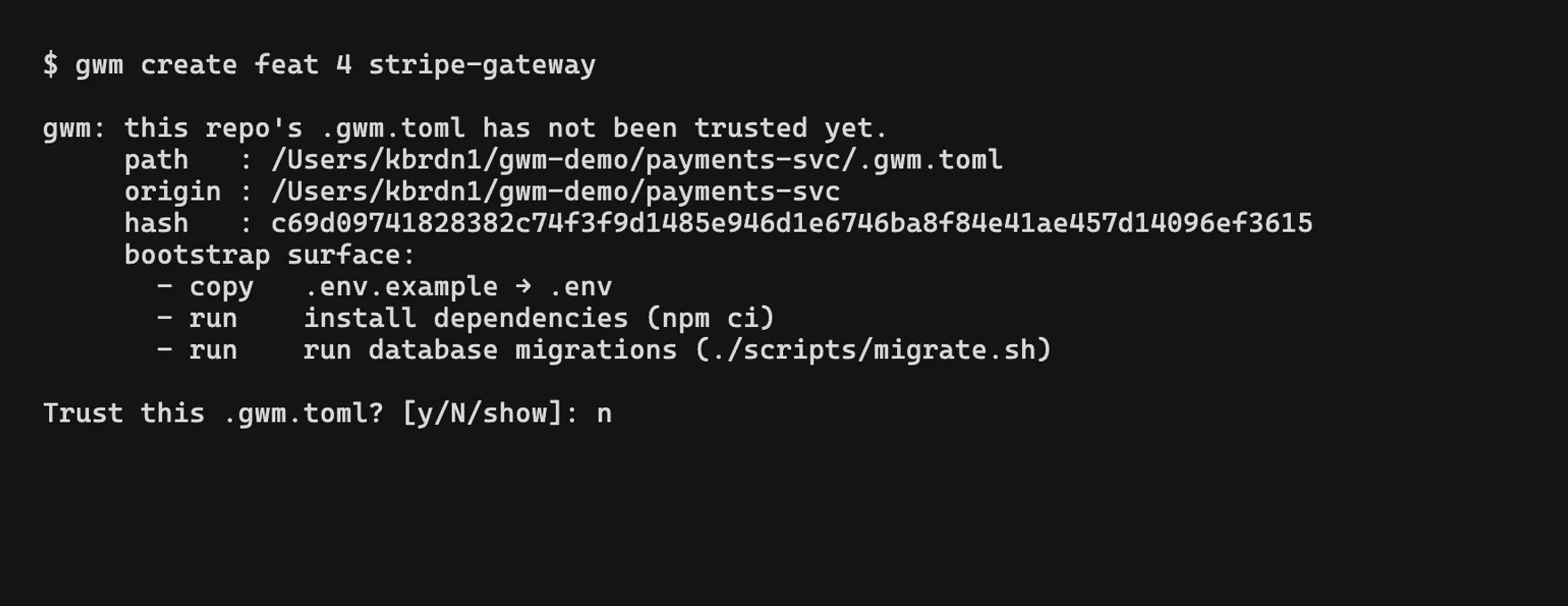
Section titled “Migration notes”The trust ledger is a soft breaking change introduced in [Unreleased]. Existing users on the first run after upgrade get a one-shot prompt per repo:
gwm: this repo's .gwm.toml has not been trusted yet.     path   : /path/to/repo/.gwm.toml     origin : git@github.com:foo/bar.git     hash   : 3a4f9c2bdeadbeef...     bootstrap surface:       - copy   .env.testing → .env.testing       - guard  no-aws-rds (on_match=seed-from-example, deny=1 pattern(s))       - run    composer install (composer install --no-interaction)
Trust this .gwm.toml? [y/N/show]:
y records and proceeds, N (or EOF / unrecognised answer) aborts, show re-prints the raw .gwm.toml. Subsequent runs are silent until the file changes.
For CI runners, set GWM_ALLOW_BOOTSTRAP=1 (or pass --allow-bootstrap) in the workflow env. The bypass does NOT record an entry: CI bypasses must not pollute the local ledger of whoever ends up running an interactive gwm from the same machine later.
Related
Section titled “Related”- CLI reference →
gwm trust: per-subcommand contract. - Bootstrap pipeline: the RCE primitive the gate protects.
- TUI keybindings:
nandbannotations re: trust gate. - Source:
src/trust.rs, whose module-level comment carries the canonical threat model. - Issue: #95.