

Bootstrap pipeline
The bootstrap pipeline runs after git worktree add succeeds, on every gwm create (unless --no-bootstrap is set) and on every gwm bootstrap. It is also re-runnable from inside the TUI via the b key.
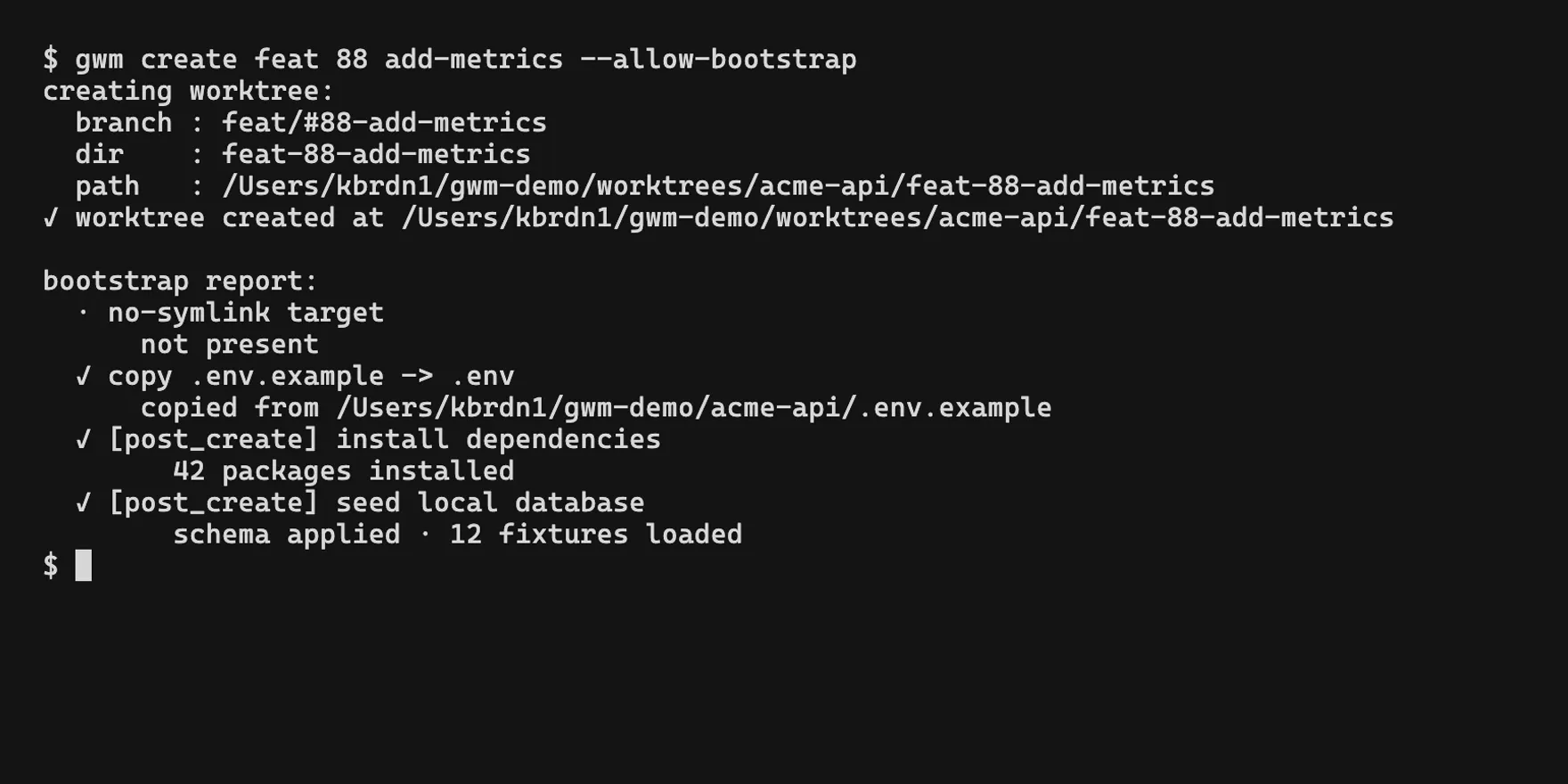
Every entry point is gated by the TOFU trust ledger: the first time you run gwm create / gwm bootstrap against a repo’s .gwm.toml, the gate prompts (CLI) or refuses with a status-bar hint (TUI) before any pipeline stage executes. Subsequent runs against the same (origin URL, sha256 of .gwm.toml) pair pass silently; any byte change to .gwm.toml re-prompts. CI bypass: --allow-bootstrap or GWM_ALLOW_BOOTSTRAP=1.
Lifecycle hooks wrap the bootstrap core:
gwm create / gwm bootstrap ↓trust gate (issue #95) prompt / refuse on untrusted (origin, hash) ↓pre_bootstrap hooks optional [[hooks.pre_bootstrap]] ↓(1) [[bootstrap.copy]] duplicate files from main → worktree ↓(2) [[bootstrap.guard]] regex deny-list each copied file ↓(3) [bootstrap.fallback.*] materialise inline content when a required source is missing ↓(4) [[bootstrap.no_symlink]] refuse to inherit listed symlinks ↓post_bootstrap hooks optional [[hooks.post_bootstrap]] ↓✓ worktree ready, status bar reports per-step ✓ / ! / ✗Stages 1 → 4 are tightly coupled: a guard seed-from-example action triggers a fallback (stage 3) inline, and the no-symlink check (stage 4) runs after copies so it can refuse links that the copy step would have followed. Legacy [[bootstrap.command]] entries are treated as post_create hooks for compatibility; prefer [[hooks.post_create]] in new configs.
Stage reports
Section titled “Stage reports”Each step prints one line with a sigil, the same convention as gwm doctor:
| Sigil | Severity | Effect on the worktree |
|---|---|---|
✓ |
success | nothing |
! |
warning | step is skipped or partial; pipeline continues |
✗ |
failure | pipeline aborts; the new worktree is rolled back |
Example output (from gwm create feat 42 user-auth with a typical config):
creating worktree:  branch : feat/#42-user-auth  dir    : feat-42-user-auth  path   : /Users/you/cc-worktree/myrepo/feat-42-user-auth✓ worktree created at /Users/you/cc-worktree/myrepo/feat-42-user-auth
bootstrap report:  ✓ copy .env.testing  ! no-symlink vendor      target not present  ✓ guard no-aws-rds on .env  ✓ run composer install  · run direnv allow      when condition 'file_exists:.envrc' false
The · sigil (used by some predicate skips) is a “step did not run” indicator and is purely informational, with no severity attached.
Skipping bootstrap
Section titled “Skipping bootstrap”gwm create feat 42 user-auth --no-bootstrap # skip the whole pipelinegwm bootstrap auth --skip-hooks pre_bootstrap # skip one lifecycle hook phaseUseful when:
- You’re scripting bulk creation and want bootstrap as a separate step.
- The repo’s
.gwm.tomlis in transition and bootstrap would fail predictably. - You want to inspect the bare worktree before any side-effects land.
Re-run bootstrap later without recreating:
gwm bootstrap # on the CWD worktreegwm bootstrap auth # ...on a fuzzy-matched nameWhy this order
Section titled “Why this order”The order is not arbitrary. It encodes the original safety lessons that motivated gwm:
- Copies first: gives guards something to inspect.
- Guards immediately after: fail fast on a
.envcontaining AWS RDS endpoints before the worktree’s shell hooks pull in real production data. - Fallbacks: when a guard fires
seed-from-example, the substitution happens before the no-symlink check looks at the result. - No-symlink: runs last among the file-level stages, so it catches any link created by a
cp -Rthat followed indirections. - Shell commands: the only stage that can have arbitrary side-effects on external systems (composer install, npm ci, etc.). Placed last so the file-level invariants hold by the time it runs.
Related
Section titled “Related”- Configuration →
.gwm.tomlschema: the TOML surface of every bootstrap section - Regex guards: how stage 2 works in detail
- when: predicates: how stage 5 conditionalises commands
- Integrations →
gwm doctor: validates that bootstrap config is internally consistent (guard refs, predicate grammar)