

.gwm.toml schema
.gwm.toml lives at the repo root. Without one, gwm uses sensible defaults (path = ~/cc-worktree/<repo>/<type>-<issue>-<desc>, no bootstrap, lazygit -p {path} as l). With one, you can configure every facet: branch naming, file copies, security guards, launcher commands, TUI behaviour, and doctor checks.
The annotated full version lives at examples/gwm.toml.example, and gwm init writes that file unchanged to your repo root.
The TUI’s Settings panel (4) is the same schema, resolved: every key with the value in force and where it came from, editable in place.
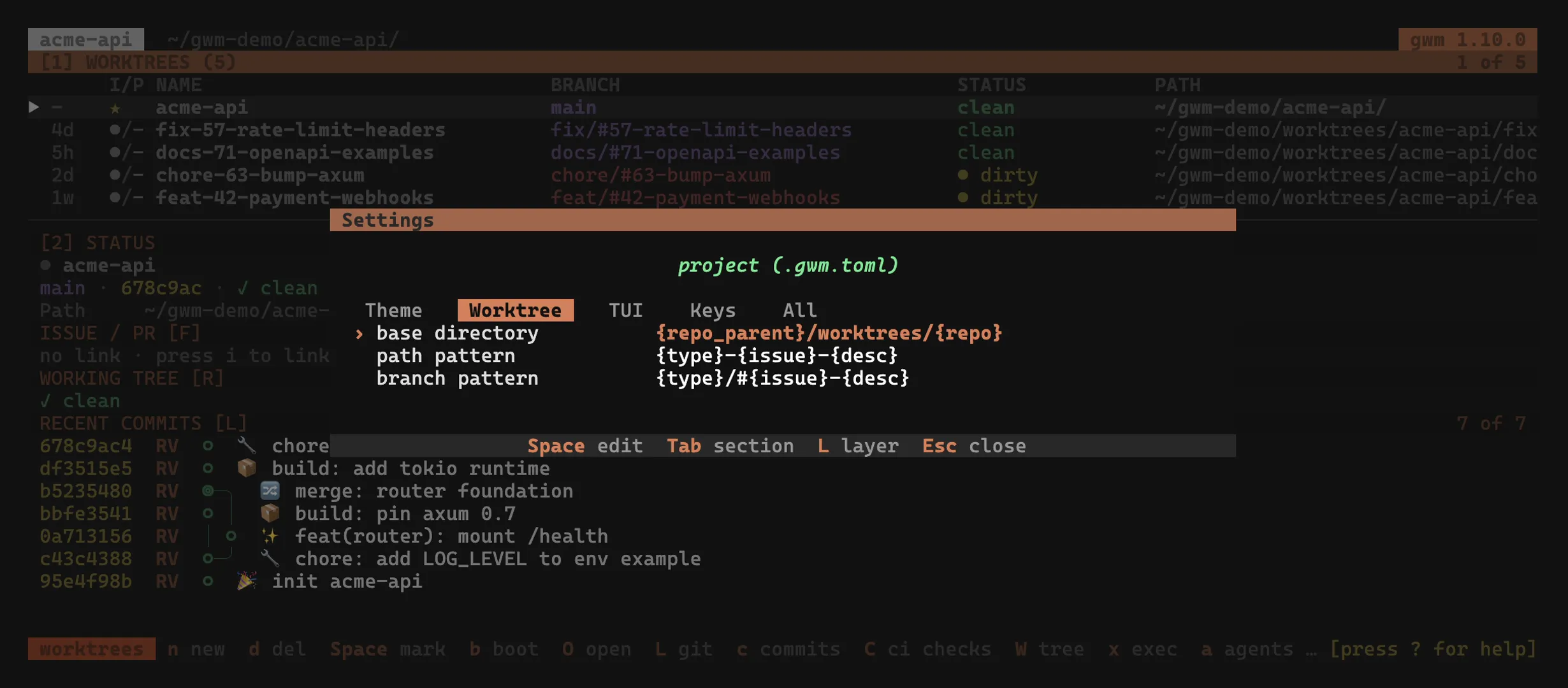
Use gwm config for scriptable reads and safe edits:
gwm config get worktree.basegwm config set tui.confirm_countdown_secs 5gwm config list --prefix reviewgwm config validategwm config set preserves existing comments and formatting, then validates the file against this schema before returning success.
The same schema may also live at ~/.config/gwm/config.toml as a user-level global config, merged underneath each repo’s .gwm.toml. See User-level global config.
[worktree]
Section titled “[worktree]”Branch and path conventions.
[worktree]base = "{home}/cc-worktree/{repo}"path_pattern = "{type}-{issue}-{desc}"branch_pattern = "{type}/#{issue}-{desc}"Placeholders: {home}, {repo}, {type}, {issue}, {desc}, {repo_path}, {repo_parent}. Tilde (~/…) is also expanded.
| Placeholder | Expands to |
|---|---|
{home} |
your home directory |
{repo} |
the repo name |
{type} |
the branch type (feat, fix, …) |
{issue} |
the issue number |
{desc} |
the description slug |
{repo_path} |
the main repo’s absolute working directory |
{repo_parent} |
the directory containing the main repo ({repo_path}’s parent) |
{repo_path} and {repo_parent} let the base sit relative to the repo on disk. For example, base = "{repo_parent}/worktrees" puts worktrees in a sibling worktrees/ dir, matching an editor’s ../worktrees convention (Zed’s git.worktree_directory) without a per-project editor config. They are additive, so existing {home} / {repo} bases are unchanged.
[worktree]base = "{repo_parent}/worktrees/{repo}" # a sibling `worktrees/` dirbranch_pattern is read back by a parser derived from itself
Section titled “branch_pattern is read back by a parser derived from itself”branch_pattern is honoured when gwm writes a branch name, and since #417 the parser that reads one back is compiled from that same pattern. One source of truth, so a repo that customises the pattern keeps issue auto-linking from the branch name, gitmoji selection, gwm pr template selection and placeholders, hook placeholders on the remove / bootstrap paths, the TUI rename, and the doctor branch-convention check.
Before #417 the reader was a fixed regex for the default {type}/#{issue}-{desc}, so all of those went quiet on a customised pattern with nothing connecting cause to effect. #415 turned that silence into a warning; #417 removed the cause.
A pattern may also freeze a segment instead of writing it from a placeholder: feat/#{issue}-{desc} hardcodes the type, {type}/#1-{desc} hardcodes the issue number. gwm reads the frozen literal back, so gitmoji, auto-linking and the rest keep working on those branches, exactly as they did before #417. What such a pattern does cost is stated separately: gwm create fix 42 x writes a feat/ branch, so the type you asked for is not the type anyone reads back, and gwm doctor says so.
Two things a derived parser genuinely cannot recover, and gwm doctor / gwm config validate name both:
-
A pattern whose split can move. The question is never “is there a separator” but “can the boundary between two placeholders land in more than one place”.
{issue}{desc}writes42123-xfrom42and123-x, which reads back as4212and3-x;{desc}{issue}is worse, becausea12is what botha+12anda1+2produce, so no parser can be right. A non-empty separator is no guarantee either:{type}-{issue}9{desc}writesfeat-42919xfrom issue42and desc19x, and the greedy\d+slides right across the9to read issue4291and descx.Both halves of the rule are narrower than they look. Adjacency alone is fine when the two alphabets are disjoint:
{type}{issue}writesfeat42, and since[a-z]+stops at the first digit and\d+at the first letter there is exactly one split. A separator inside the left placeholder’s charset is fine too, as long as the right one cannot supply it back:-after{desc}can be swallowed but never reappear, because an issue number cannot contain it, so{desc}-{issue}stays legal. Even a multi-character separator only counts if the left side can eat a repeating prefix of it, which is why{type}-{issue}9-{desc}works where{type}-{issue}9{desc}does not. Everything that fails is refused with a message naming the fix. -
A segment the pattern neither writes nor freezes.
{type}/{desc}has no{issue}and no literal number to stand in for one, so nothing can read an issue out of a branch it wrote. The warning says which placeholder to add.
The two commands differ on exit code, which matters if you gate CI on them:
| Command | On a pattern that does not round-trip |
|---|---|
gwm config validate |
prints the warning on stderr, exits 0, since a custom pattern is valid configuration rather than an error |
gwm doctor |
reports a ! check, so the run exits 1 like any other Warning (exit codes) |
A CI job that runs gwm doctor and tolerates Warnings should use gwm doctor; [ $? -le 1 ].
config validate reads the effective pattern, so one set only in the global ~/.config/gwm/config.toml is caught too.
path_pattern is unaffected: it is generation-only, and a worktree’s name comes from its directory rather than from re-parsing the pattern.
Which patterns work
Section titled “Which patterns work”The field stays free-form. The table below is verified against the real check, not assumed: a test pins it so it cannot drift.
Round-trips fully, so every branch-name feature keeps working:
| Pattern | Note |
|---|---|
{type}/#{issue}-{desc} |
the default |
{type}-{issue}-{desc} |
slash-less, and unambiguous: - is in neither [a-z]+ nor \d+ |
{type}_{issue}_{desc} |
any separator works, as long as there is one |
{type}/{issue}-{desc} |
the # is decoration, not structure |
{type}/#{issue}_{desc} |
|
{repo}/{type}/#{issue}-{desc}, wt/{type}/#{issue}-{desc} |
extra leading segments are fine |
{type}/#{issue}-prefix-{desc} |
a literal wedged between placeholders is fine |
{type}/#{issue}-{desc}-{repo} |
so is one appended after {desc} |
{desc}/#{issue}-{type} |
the order is yours |
{type}/#{desc}-{issue} |
a - after {desc} is legal: \d+ can never contain it, so there is one split |
{type}{issue}-{desc}, {issue}{type}-{desc} |
adjacent, but [a-z]+ and \d+ share no character, so the split cannot move |
{type}-{issue}9-{desc} |
\d+ can eat the 9 but never the - that would have to follow it |
Refused as unreadable, with an error naming the fix:
{issue}{desc},{desc}{issue},{type}{desc}: adjacent placeholders whose alphabets overlap, so a character can cross the split{type}-{issue}9{desc},{type}a{desc},{desc}1{issue}: a separator both neighbours could contain, so the split can move{desc}-{desc}: the same placeholder twice, since every occurrence expands to the same value
Freezes a segment. The literal is read back, so nothing stops working on the branches these produce. What is lost is the argument gwm create was given, and gwm doctor names it:
feat/#{issue}-{desc}: every branch is afeatbranch, whatever type you pass. Harmless whenfeatis the only configured branch type, andgwm doctorstays quiet in that case{type}/#1-{desc}: every branch links to issue 1{type}/#{issue}-fixed: every branch has the descriptionfixed
The TUI rename form shows a frozen segment, and whether it can be changed depends on where the new value could go. The question is the formatter’s, so all three patterns it expands are asked: branch_pattern, worktree.path_pattern, and [worktree].base. When the path pattern writes the segment, editing it renames the worktree directory; when base writes it, the worktree moves between base directories, which is what a base of .../{type} is for. Either way the branch is left alone, which is a real rename and is allowed, and the modal’s preview states it by showing the branch unchanged. Only when none of the three writes the segment is the edit refused, because the submit would rebuild the same branch at the same path. Segments branch_pattern writes are always editable.
The value it shows comes from the worktree’s directory when path_pattern carries the segment and branch_pattern does not (#478). Under branch_pattern = "feat/#{issue}-{desc}" with the default path_pattern, gwm create fix 42 x writes the branch feat/#42-x and the directory fix-42-x, and fix exists nowhere else, so renaming the description keeps it instead of moving the directory to feat-42-…. The branch always wins for a segment it writes itself: a directory renamed by hand never rewrites the worktree’s identity.
The recovery is positional first, then an exact match, never a guess. A literal is only read as a segment if it sits where that segment goes: before {issue} for a type, after it for a description. So feat/#{issue}-fix recovers both, even though feat and fix are each a configured branch type, and wt/{type}/#{issue} recovers nothing, since wt sits before the type, where no segment goes, so it stays the namespace it looks like. Then each candidate is put to its own test: a branch type is looked up in the repo’s configured list, so feature/#{issue}-{desc} recovers nothing (feature names a namespace, not a type); an issue number has to be all digits; a description is whatever DESC_RE accepts. A segment is recovered when every reading of the pattern names it with the same value, and the rule is per segment: feat/fix-{issue}-{desc} names two different configured types in the same position and recovers neither, feat/feat/#{issue}-{desc} reads feat whichever of its two candidates is taken and so freezes the type like any other literal, and feat/#{issue}-fix/done is read two ways that disagree about the description while both saying feat, so it recovers the type and not the description.
Carries no such segment at all, so gwm doctor warns and says which placeholder to add:
{issue}-{desc}: no{type}and no literal type to freeze one from{type}/{desc}: no{issue}, so issue auto-linking from the branch name is inactive{type}/#{issue}: no{desc}
One shape the compiler does not mirror: a pattern starting with ~, because the writer runs tilde expansion as its last step and the reader has no way to undo it. gwm doctor reports it as a pattern nothing reads back.
Supported branch types
Section titled “Supported branch types”feat, fix, hotfix, docs, test, refactor, chore, perf, ci, build. Override per repo if your team uses something else.
[[bootstrap.copy]]
Section titled “[[bootstrap.copy]]”File copies from the main checkout into the new worktree.
[[bootstrap.copy]]from = ".env.testing"to   = ".env.testing"required = truefallback = "inline"        # inline | skip | abort (default: skip when required=false)
[[bootstrap.copy]]from = ".env"to = ".env"required = falseguards = ["no-aws-rds"] # reference into [[bootstrap.guard]]| Field | Type | Default | Meaning |
|---|---|---|---|
from |
string | (required) | source path, relative to the main checkout |
to |
string | (required) | destination path, relative to the new worktree |
required |
bool | false |
when true, missing source aborts the bootstrap unless fallback saves |
guards |
list of strings | [] |
names of [[bootstrap.guard]] rules to apply after the copy |
fallback |
string | none | inline (use [bootstrap.fallback.<key>]), skip, or abort |
See Bootstrap pipeline for execution order.
[[bootstrap.guard]]
Section titled “[[bootstrap.guard]]”Regex deny-lists on copied files, generalised from the original “no AWS RDS in .env” use case.
[[bootstrap.guard]]name = "no-aws-rds"deny_patterns = ["amazonaws\\.com", "\\.rds\\."]on_match = "seed-from-example" # abort | seed-from-exampleexample_file = ".env.example"See Regex guards for the full pattern API.
[bootstrap.fallback.<key>]
Section titled “[bootstrap.fallback.<key>]”Inline content used when a required [[bootstrap.copy]] source is missing and fallback = "inline".
[bootstrap.fallback.env_testing]target = ".env.testing"content = """APP_ENV=testingDB_CONNECTION=sqliteDB_DATABASE=:memory:"""The <key> is referenced implicitly by matching target to a copy step’s to. Multiple fallbacks may coexist.
[[bootstrap.no_symlink]]
Section titled “[[bootstrap.no_symlink]]”Refuse to inherit a symlink at the listed path (typically vendor/, node_modules/), which stops a stray symlink from polluting the main repo’s build output.
[[bootstrap.no_symlink]]path = "vendor"
[[bootstrap.no_symlink]]path = "node_modules"
[[bootstrap.command]]
Section titled “[[bootstrap.command]]”Legacy shell hooks. New configs should prefer [[hooks.post_create]]. When a config defines both legacy [[bootstrap.command]] entries and any [hooks.*] entries, gwm prints a deprecation warning and treats the legacy commands as extra post_create steps to avoid ordering ambiguity.
[[bootstrap.command]]name = "composer install"run = "composer install --no-interaction --prefer-dist"when = "file_exists:composer.json"env = { COMPOSER_IGNORE_PLATFORM_REQ = "ext-imagick" }| Field | Type | Meaning |
|---|---|---|
name |
string | shown in the bootstrap report |
run |
string | shell line to exec (split via sh -c) |
when |
string | when: predicate (optional) |
env |
table of string→string | extra env vars injected for this command (optional) |
[[hooks.*]]
Section titled “[[hooks.*]]”Lifecycle hooks run around worktree creation, bootstrap, and removal. Supported phases:
[[hooks.pre_create]]: beforegit worktree add, withcwdat the main repo.[[hooks.post_create]]: after the worktree exists, withcwdat the worktree.[[hooks.pre_bootstrap]]/[[hooks.post_bootstrap]]: around the bootstrap core.[[hooks.pre_remove]]/[[hooks.post_remove]]: before and after a removal, whether it came fromgwm removeor fromdin the TUI.
[[hooks.post_create]]name = "install deps"run = "npm ci"when = "file_exists:package-lock.json"on_fail = "warn" # abort | warn | ignore (default: abort)env = { CI = "1" }| Field | Type | Meaning |
|---|---|---|
name |
string | shown in lifecycle reports as [phase] name |
run |
string | shell line to exec via sh -c |
when |
string | when: predicate (optional) |
env |
table of string→string | extra env vars injected for this hook (optional) |
on_fail |
string | abort, warn, or ignore; default is abort |
Hook commands and env values can use placeholders: {branch}, {path}, {type}, {issue}, {desc}, {user}, {owner}, {repo}.
A placeholder is a value, not a fragment of script. In run, each substituted value is shell-escaped, so a branch name carrying ;, |, $, a backtick or a space arrives at your command as one argument instead of changing what the command is. Git permits all of those in a ref, and a ref can come from someone else’s push. Substitution is single-pass, so a value that itself contains a {token} is passed through untouched rather than expanded a second time. In env, values are not escaped: they go straight to the process environment and never see a shell, so escaping them would put literal quote characters into what your hook reads back.
One consequence worth knowing: an empty placeholder now expands to an empty argument rather than to nothing at all. On a branch that does not match the branch convention, {type} / {issue} / {desc} are empty, so mycmd {issue} passes mycmd one empty argument where it previously passed none. Inside a larger word (mycmd issue={issue}) nothing changes.
The same context is exported as environment variables, so a hook can skip placeholder syntax entirely:
| Variable | Same as |
|---|---|
GWM_BRANCH |
{branch} |
GWM_PATH |
{path} |
GWM_TYPE |
{type} |
GWM_ISSUE |
{issue} |
GWM_DESC |
{desc} |
GWM_USER |
{user} |
GWM_OWNER |
{owner} |
GWM_REPO |
{repo} |
[[hooks.post_create]]name = "notify"run = 'printf "%s is ready at %s\n" "$GWM_BRANCH" "$GWM_PATH"'Quote them ("$GWM_BRANCH", not $GWM_BRANCH): a shell never re-parses metacharacters coming out of a variable, so nothing there can start a second command, but an unquoted expansion is still subject to word splitting and filename globbing, and a ref may contain a tab, a newline or a *. An explicit env entry with the same name wins over the exported one.
Emergency bypass:
gwm create feat 42 auth --skip-hooks pre_creategwm bootstrap auth --skip-hooks pre_bootstrap,post_bootstrapgwm remove auth --force # implies --skip-hooks pre_remove,post_removeThe TUI has no --skip-hooks: d is the plain form of gwm remove, so a
pre_remove that refuses refuses there too. To delete past a hook, use the
CLI with --force.
Running a hook means executing code out of .gwm.toml, so the TUI checks the
trust ledger before a delete in a repo whose
config defines pre_remove or post_remove steps. The alternate screen
cannot host the approval prompt, so an unapproved config refuses the delete
rather than skipping the hook; gwm trust add from a terminal approves it,
and --allow-bootstrap (or GWM_ALLOW_BOOTSTRAP=1) at launch bypasses the
ledger for the session. A config whose hooks are all post_create runs
nothing on a delete and is never asked.
[git_tui] and [review]
Section titled “[git_tui] and [review]”The TUI launcher bindings. Full schema lives in TUI → Configurable launchers.
# l keybinding — pre-v0.6 default kept implicit when omitted[git_tui]command    = "lazygit -p {path}"fullscreen = true
# R keybinding — inert until configured[review]tool         = "lumen"                # OR command = "<your line>"fullscreen   = true                   # only honoured when command is setdefault_base = "main"                 # optional override for the base resolution chain
[exec] and [clean]
Section titled “[exec] and [clean]”Named profiles for the gwm exec and gwm clean fan-out commands (issue #324). Both blocks are opt-in: without them, gwm exec -- <cmd> and the built-in gwm clean set behave exactly as before.
[exec]jobs = 1                             # global default parallelism; 1 = sequential
# Saved commands for `gwm exec --profile <name>`.[exec.profiles.test]command = ["cargo", "test"]          # argv ARRAY — no shell
[exec.profiles.fmt]command = ["cargo", "fmt", "--all"]jobs = 4                             # this profile fans out 4 at a time
# Run a profile's command inside a container (issue #421).[exec.profiles.ci]command = ["cargo", "test", "--all-features"]
  [exec.profiles.ci.container]  image      = "rust:1.90"           # required  runtime    = "podman"              # optional; auto-detected (docker, then podman)  extra_args = ["-e", "CI=1", "-v", "gwm-cargo:/usr/local/cargo/registry"]
# Saved directory sets for `gwm clean --profile <name>`.# `default` is what `gwm clean` uses WITHOUT --profile.[clean.profiles.default]dirs = ["target", "node_modules", "dist", "build", "coverage", ".turbo"]
[clean.profiles.deep]dirs = ["target", "node_modules", "dist", "build", ".cache", ".venv"]
exec: command is an argv array, not a shell line. A profile’s command is a list of argv tokens (["cargo", "test"]) run with no shell: no word-splitting, no globbing, no {path} placeholders. The program is executed verbatim in each worktree, exactly like the inline gwm exec -- <cmd>. This is a deliberate divergence from [git_tui] and [review], whose command is a single shell line ("lazygit -p {path}"). The two semantics are frozen for 1.0; don’t expect shell features under [exec.profiles].
gwm exec --profile <name>runs the saved command.--profileand an inline-- <cmd>are mutually exclusive (passing both exits 1); an unknown profile name exits 1.
exec: jobs is bounded parallelism. [exec] jobs is the global default; a profile’s jobs overrides it; the --jobs <n> flag wins over both. Precedence: --jobs > [exec.profiles.<name>].jobs > [exec] jobs > 1. 1 (or absent) runs sequentially with live, inherited output, the unchanged default. > 1 runs up to N worktrees at once, capturing each one’s output and printing it as a per-worktree block (in worktree order) once the fan-out completes, so concurrent runs don’t interleave. The aggregate exit code is unchanged: non-zero if any worktree’s command failed.
exec: [container] runs a profile’s command inside a container. [exec.profiles.<name>.container] wraps the profile’s command in <runtime> run instead of running it on the host. It rides a profile only: the inline gwm exec -- <cmd> always runs on the host, whatever the config says, so a command line that used to run locally never starts a container behind your back. A containerised run announces itself in the per-worktree header: ━━ feat-1 (/path/to/feat-1) [docker rust:1.90].
| key | meaning |
|---|---|
image |
required, non-empty. The image to run, e.g. "rust:1.90" |
runtime |
The container CLI. Absent ⇒ auto-detected: docker first, then podman. Any Docker-compatible CLI works (nerdctl, a wrapper script); an explicit value is honoured even if it isn’t on PATH |
extra_args |
Extra run flags, spliced in after gwm’s own and before the image: ["-e", "CI=1"], ["-v", "cache:/root/.cargo"], ["--network", "none"] |
selinux_relabel |
Suffix gwm’s own mounts with :z, for an SELinux-enforcing host (Fedora, RHEL). Off by default because relabelling writes to the host, recursively, on the worktree and the main checkout’s .git. extra_args cannot express it: it cannot reach the mounts gwm builds itself |
The command gwm builds for each worktree:
<runtime> run --rm -v <worktree>:<worktree> -v <main>/.git:<main>/.git -w <worktree> \ -e GIT_CONFIG_COUNT=2 -e GIT_CONFIG_KEY_0=safe.directory -e GIT_CONFIG_VALUE_0=<worktree> \ -e GIT_CONFIG_KEY_1=safe.directory -e GIT_CONFIG_VALUE_1=<main>/.git \ <extra_args…> <image> <cmd…>Host paths are mirrored, and the main checkout’s gitdir is mounted alongside. This is the point of the feature rather than a detail. A linked worktree’s .git is not a directory, it is a file holding the absolute host path of <main>/.git/worktrees/<id>. Mount only the worktree and that path does not exist inside the container: no git status, no git describe to stamp a version, no commit, no hook, and no coding agent that touches git. Mounting the main checkout’s .git at its own host path fixes it, and once a host-absolute path has to be reproduced anyway, a /workspace mount point buys nothing, so -w is the worktree’s own path and {path} / GWM_PATH stay true on both sides. When the gitdir already lives inside the worktree (the main checkout, reachable via an explicit slug), the first mount covers it and the second is skipped.
- Every mounted path is declared
safe.directory. With a rootful Docker on Linux the container runs as uid 0 while the bind-mounted tree belongs to you, and git refuses a repository it reads asdubious ownership, which would undo the mount above. gwm declares the paths it mounts itself throughGIT_CONFIG_*environment: nothing is written to any config file, and the blanket*is never used, so the ownership check stays on for everything else. It is the same fix CI providers apply to their own checkouts. What this does not change is file ownership: with a rootful daemon, files the command creates (atarget/, anode_modules/) belong to root on the host. Addextra_args = ["--user", "1000:1000"]if that matters to you, keeping in mind that some images expect root (a writableCARGO_HOME,apt-get). gwm execallocates no TTY; the TUI overlay does. A fan-out over N worktrees has no use for a terminal per container. The TUI exec overlay (e) spawns into a real pty, so there the container is started with-i -tand a REPL, a debugger or any prompting command keeps working, exactly as it does when the profile runs on the host.- Not supported on Windows. The wrapper mirrors host paths, and
C:\…is neither mountable nor resolvable inside a Linux container. Worse, a linked worktree’s.gitfile would still name a drive-letter path, so even a translated mount would leave git unable to answer, which is the one thing this feature exists to guarantee. A profile carrying[container]is refused there with a message saying so, rather than handed todocker runto fail obscurely. - argv, never a shell string. gwm hands
docker/podmanan argument vector; nothing is quoted, joined, or re-parsed by a shell at any point. This is an invariant, not a happy consequence (see GHSA-fffq-vg6f-gxqm, branch-name injection through a shell hook). - The command is the container’s CMD, so an image with an
ENTRYPOINTreceives it as arguments.extra_args = ["--entrypoint", ""]opts out. The stock language images (rust,node,golang, …) declare no entrypoint, so the plain form works for them. - No
interactive/ TTY knob.gwm execis a fan-out over N worktrees, where a TTY per container means nothing. It will come with the surfaces that can honour it (the multiplexer windows, the PTY overlay), not here. extra_argscome last, so they win. A repeated flag overrides gwm’s:["-w", "/workspace"]moves the working directory. Taking that means owning the consequence: the worktree is still mounted at its host path, so-w /workspacepoints at a directory the container does not have. If you also remount it (["-v", "<worktree>:/workspace", "-w", "/workspace"]), the.gitfile inside it still names the host path, and git will only answer because the gitdir mount is there.- The container is removed when the TUI overlay closes. Killing a
docker runclient does not stop the container: the daemon owns it, and--rmonly fires once it exits. So a long command would keep writing to the worktree after the overlay visibly closed. The overlay names its container (--name gwm-<worktree>-<pid>-<n>, carrying gwm’s pid so two gwm processes on the same worktree cannot agree on a name and tear down each other’s container) and removes it on close, from the worktree, so a relativeruntimeresolves the same way it did on the way in.--nameinextra_argsis refused for that reason: a runtime honours the last one it is given, which would leave the teardown removing something else. Thegwm execfan-out needs none of this, since it never kills its client mid-run. - A
:in the worktree path is refused. It is legal on Unix but is the field separator of-v source:destination, so such a mount cannot be expressed. gwm says so instead of letting the runtime reject the spec with a message about neither the worktree nor gwm. - For caches, prefer a named volume to a host path.
.gwm.tomlis committed and travels between machines, so-v gwm-cargo:/usr/local/cargo/registryis portable where/Users/you/.cargois not. There is no~or$VARexpansion inextra_args: tokens are passed through verbatim. - Any Docker-compatible socket works, with nothing to integrate. OrbStack, Colima, Rancher Desktop, Docker Desktop and native Linux Docker all expose the
dockerCLI; gwm only builds an argv for it. Listing them as “supported runtimes” would be marketing rather than integration.
clean: a profile’s dirs is a complete set that replaces the built-ins. [clean.profiles.<name>].dirs does not add to the built-in target/node_modules/dist/build: it replaces them wholesale. Each entry must be a single worktree-relative directory name, one path component. An absolute path, a .. traversal, an empty string, a bare . (which resolves to the worktree root), a nested path like target/debug, or a name with git pathspec metacharacters (* ? [ ] or a leading :) is rejected (exit 1). The nesting restriction is deliberate for 1.0 (an intermediate component could be a symlink the scan/delete would follow out of the worktree); the metacharacter restriction keeps the git-ignored / tracked-file safety checks matching the literal directory. A leading - is fine. Exact duplicate entries are dropped so a directory is reclaimed once. The safety gate (git-ignored + no tracked files + skip symlinks) still applies to every directory in the set.
gwm cleanwithout--profileuses[clean.profiles.default]when present, else the built-in four.gwm clean --profile <name>uses that profile’s set; an unknown name exits 1.
Runtime knobs for the worktree TUI.
[tui]# Safety countdown (in seconds) for the delete-confirm overlay when `p` is armed.# Accepts 0..=5; values above 5 are clamped on read. Setting it to 0 keeps the# classic single-keystroke modal even when delete-branch-on-remove is armed.confirm_countdown_secs = 3
# Which side the worktree-details sidebar sits on in the side-by-side layout.# "right" (default, pre-#188 behaviour) or "left". Toggle it live with `v`.sidebar_position = "right"
# How the sidebar is arranged relative to the table: "stacked" (default),# "side-by-side", or "auto" (width-driven). Cycle it live with `z`.sidebar_orientation = "stacked"
# How panes and sidebar sections are framed: "compact" (default, filled# one-line headers) or "bordered" (the lazygit-style boxes, gwm's layout up# to 1.7). See "layout" below.layout = "compact"
# Dim the body of whichever pane does not hold focus. Off by default — it# trades contrast for a stronger "where am I" signal. Applies to both layouts.dim_unfocused = false
# Fold the sidebar's Status block onto one line (branch · head · state ·# diff · age). On by default; set to false for the labelled four-row block.status_one_line = true
# Give the in-TUI note editor (`N`) a vim normal mode. On by default: the# first `Esc` leaves insert, and the second one writes and closes. Set it to# false for the modeless editor, where one `Esc` writes and closes.note_vim = true
# What the TUI opens in the multiplexer: "pane" (default), "tab" (a whole# tmux window / zellij tab / herdr tab), or "workspace" (herdr only).mux_open_in = "pane"
# Which half a mux pane takes: "right" (default), "down", "left" or "up".# herdr takes only the first two. Only meaningful under mux_open_in = "pane".# Also the direction a CLI `--split` takes.mux_pane_direction = "right"
# Command that renders a URL inside the terminal, taking an optional {url}# placeholder. Only used when a multiplexer is detected; unset (the default)# sends every link to the external browser, as gwm always has.terminal_browser = "w3m {url}"
# Who places that browser: "overlay" (gwm hosts it in a pane or the PTY# overlay, the default) or "detached" (the browser splits on its own and gwm# only launches it).terminal_browser_open_in = "overlay"
# How yanked text reaches the clipboard: "auto" (OSC52 over SSH, host tools# otherwise), "osc52", or "tools".clipboard = "auto"
# Periodic worktree-list refresh interval, in seconds. Default 60 keeps the# Issue/PR table state reasonably fresh; set to 0 to disable the auto-refresh# loop entirely (you can still refresh on demand with the `refresh` key).auto_refresh_secs = 60
sidebar_position (issue #188) sets the default side of the details sidebar in the side-by-side layout: "right" (default) or "left". v toggles it live in the TUI. The stacked layout (table on top, sidebar below) ignores this, since there the sidebar is always at the bottom. An unknown value is a hard config error at load time.
sidebar_orientation (issue #365) sets how the sidebar is arranged relative to the table:
| Value | Behaviour |
|---|---|
"stacked" |
Table on top, sidebar below. Default since issue #217, because the status pane reads best at full terminal width. |
"side-by-side" |
Always beside the table, whatever the terminal width. |
"auto" |
Side-by-side at >= 120 columns, stacked below that. |
z cycles it live (auto → side-by-side → stacked → auto; it was Space before #484). Before #365 that live choice was runtime-only and reset on every launch; setting the key here makes it stick. An unknown value is a hard config error at load time. It is also exposed in the Settings panel under the TUI tab.
Layout
Section titled “Layout”layout (issue #545) chooses how panes and sidebar sections are framed. A bordered section spends two rows and two columns on its frame plus a third row on its bottom-rule counter; a compact one spends a single row.
"compact" (default) |
"bordered" |
|
|---|---|---|
| Section frame | one filled header line | four rules, title in the top one |
| Title | ISSUE / PR [F] (uppercased) |
Issue / PR [F] |
| Counter | right of the header line | bottom rule, right-aligned |
| Focus signal | header fill (a darkened accent band when focused, section_bg otherwise) + a bold title |
border colour |
| Pane boundary | a muted rule between the two panes |
the boxes themselves |
| Worktrees pane height | its row count, capped at its share | its share of the stacked split |
| Modal frame | a filled title band, a section_bg footer band, no rules |
four rules, title in the top one |
| Modal padding | one blank row at each end of the content, one column each side | one blank row and two columns each side |
"compact" is the default. The density is the point: the box rules were the single largest source of wasted space on screen, and the mode buys back two rows and two columns per section.
"bordered" reproduces gwm’s layout up to 1.7 for users who prefer it. It is deliberately left untouched by the compact-mode refinements - no dimming, no separator rule - so it stays a faithful restore rather than a third look.
An inactive header is the section_bg theme role, an indexed colour rather than a translucent white so it stays readable on a terminal without truecolor, with the title on it in accent. The focused one trades the pair (#605): an accent band carrying that section tone as its text, bold - the dark-on-colour treatment the version chip and the footer’s context anchor already use. The band is accent pulled down toward section_bg, mixed from the two rather than declared as its own role, so overriding either keeps them in tune; a palette with nothing to mix - an ANSI colour name, whose value belongs to the terminal, or a 256-palette index - keeps accent itself, which is the default theme’s case. Not focus, which is the border tone and more saturated. How far it is pulled down is bounded by the dark text on it: the two keep a 3:1 contrast.
Neither state uses muted: a pane’s name is how you find the pane to Tab into, so it stays legible when the pane is inactive. Focus adds weight to the whole header line on top of the fill. A span that carries its own colour keeps it on either band - the filter / prompt, the Working Tree per-category counts - because the header style is patched onto a span rather than substituted for it.
Overlays and modals follow the knob too (issue #594). Compact gives them the same treatment the panes get: the title on a filled band across the first row, no rules on any side, and the row every modal already spends on its key hints painted as a quiet section_bg band, which is two rows and four columns back per overlay. Content never sits flush against a band at either end: the frame keeps a blank row under the title, and every modal leaves one above its hints (the four full-size overlays and the note editor gained theirs with #594, in both layouts). The bottom-rule counter a bordered modal carries (the Working Tree’s per-category counts) moves to the right of that band, where a compact pane puts its own.
A panel floating over content is where a rule earns its keep, which is what the missing rules cost. What replaces them is the ground: while a compact modal is up, everything behind it is darkened, the colours mixed toward black rather than just DIM, because DIM touches the foreground only and the pane header band directly above a full-size overlay would otherwise read as part of it. A palette with no components to mix keeps DIM alone. bordered is left alone here as everywhere else: it already has its boundary.
An unknown value is a hard config error at load time. layout, dim_unfocused, status_one_line, note_vim, mux_open_in, mux_pane_direction, terminal_browser and terminal_browser_open_in are also exposed in the Settings panel under the TUI tab (4), where cycling the choice applies live.
dim_unfocused
Section titled “dim_unfocused”dim_unfocused dims the body of whichever pane does not hold focus. Off by default, and it applies to both layouts - the signal is about focus, not about how a pane is framed.
It ships off because it is a trade-off rather than a strict improvement: the inactive pane’s content is still information you may be reading, and dimming costs contrast on a surface that is often a screenshot. Users who move between the two panes constantly get a stronger “where am I” cue by turning it on.
The dimming uses the terminal’s DIM attribute rather than repainting in muted, so the body keeps its semantic colours - a dirty branch stays yellow, a staged file stays cyan. A terminal that ignores DIM simply renders as if the option were off, where the header fill (compact) or the border colour (bordered) still carries the signal.
status_one_line
Section titled “status_one_line”status_one_line (issue #547) folds the Status block’s four values onto a single row. On by default.
status_one_line = true                      status_one_line = false
feat/#42-webhooks · f9e8a58 · ● dirty …     Branch   feat/#42-webhooks · f9e8a58Path     ~/cc-worktree/webhooks             Created  1w                                            Diff     +2 -0                                            State    ● dirty                                            Path     ~/cc-worktree/webhooks
Four labelled rows for four values of a handful of characters each was the sidebar’s largest remaining waste once #545 cut the chrome. The fold buys back three rows and hands them to the panes below.
It is a knob rather than a compact-mode behaviour, so it applies under both layouts - bordered folds too unless you turn this off. The Path row is never folded in: a path is the one value long enough that sharing a row would clip the path and whatever joined it.
Segment order is the width policy. The sidebar does not wrap, so a row wider than the pane is clipped on the right: identity (branch, head) leads because it is what the row is for, and Created trails because it is the value the pane can most afford to lose. Every segment keeps the theme role it wears in the labelled block.
note_vim
Section titled “note_vim”note_vim (issue #557) gives the in-TUI note editor (N) a vim normal mode. On by default.
N opens in normal mode, i / I / a / A / o / O enter insert, Esc goes back to normal, and the second Esc writes and closes. The motions are hjkl, w / b / e and their W / B / E, 0 / ^ / $, gg / G, plus x and dd. The full table is in TUI → keybindings.
That second sentence is the cost, so it is worth stating on its own: the first Esc no longer writes and closes. Set note_vim = false and the editor is exactly the one #515 shipped, where every printable is text and one Esc writes and closes.
It changes no binding: [tui.keys.modal.note] holds the same four verbs either way, and an unmodified printable bound to one of them is refused at load time with or without the mode. What it does change is what unbound printables mean, which is why the modal title carries a NORMAL / INSERT chip while it is on.
No counts, no registers, no undo. Ctrl+e still hands the file to the real vim, and that handoff is the answer for anything this mode does not cover.
mux_open_in
Section titled “mux_open_in”mux_open_in (issue #608) decides what the TUI opens in the multiplexer, for both t on the worktree list and o on the agent sessions overlay. A multiplexer nests panes inside tabs, and herdr nests tabs inside workspaces; this picks the level.
| Value | Behaviour |
|---|---|
"pane" |
Default. Split the current pane. Which half it takes is mux_pane_direction below. |
"tab" |
A whole screen of its own: a tmux window, a zellij or herdr tab. One thing under three names; the status bar uses your backend’s word. |
"workspace" |
herdr’s level above a tab. herdr only. |
"workspace" is refused on tmux and zellij, not downgraded. Neither has a level there, so t says so on the status bar and opens nothing:
tmux has no workspace level: herdr is the only backend with oneQuietly opening a tab instead would leave the setting describing something that did not happen, which is worse than a key that refuses and explains itself. The two backends do have sessions, which is the structural analogue, but gwm runs inside one: tmux would need two commands to create and switch to a sibling, and zellij refuses to nest sessions at all.
Under "workspace", herdr runs herdr workspace create --label <name> --cwd <path> --focus. It is tab create minus the --workspace it would be creating.
A [tui.macro*] with open_in = "mux_pane" reads this key too, and under "workspace" it falls back to the PTY overlay on every backend: tmux and zellij have no workspace, and herdr’s workspace create takes no trailing command any more than its tab create does. The status bar names which one refused.
This key does not reach the CLI. gwm tmux|zellij|herdr <pattern> spells its own target: bare is a tab, --split is a pane. There is no workspace flag, and --workspace is taken by the repo-set flag (issue #36).
mux_pane_direction
Section titled “mux_pane_direction”mux_pane_direction (issue #589) decides which half a pane takes, under mux_open_in = "pane" and on the CLI’s --split. Both TUI keys that open one read it: t and o.
| Value | Behaviour |
|---|---|
"right" |
Default. Side by side: tmux split-window -h, zellij action new-pane --direction right, herdr pane split --direction right. |
"down" |
Stacked below: tmux split-window -v, --direction down on the other two. |
"left" |
Side by side, other side: tmux split-window -h -b, --direction left on zellij. Refused by herdr. |
"up" |
Stacked above: tmux split-window -v -b, --direction up on zellij. Refused by herdr. |
right is a behaviour change for tmux and zellij users, and a deliberate one. Up to 1.9 a split carried no direction, so each backend answered for itself: tmux fell back to -v and stacked the pane, zellij took “the biggest available space”, and herdr went right because gwm hardcoded it there. right is what the --split help has promised since it shipped (“a horizontal split of the current pane”), and the half that is actually free on a wide screen. Set mux_pane_direction = "down" to get the old tmux behaviour back.
-b is where the second pair comes from, and it is worth knowing before reading tmux’s flags as the words suggest: -h is the horizontal split and puts the pane to the right, -v stacks it below, and -b (“before”) flips the side on whichever axis was picked. Measured on tmux 3.7c by reading the new pane’s geometry back through split-window -P -F rather than inferring it from pane order.
left and up are refused on herdr, which declares its --direction as [possible values: right, down] (0.8.2). The status bar says so rather than substituting a direction herdr does have:
herdr splits only right or down: left and up are tmux and zellij directionsThis is mux_open_in = "workspace" inverted: there one backend can do what the other two cannot, here two can do what the third cannot. An unknown value is a hard config error at load time, and so is "window", which moved to mux_open_in = "tab".
On the CLI, gwm tmux|zellij|herdr <pattern> --split takes its direction from here unless --direction <dir> overrides it for that one invocation.
terminal_browser
Section titled “terminal_browser”terminal_browser (issue #590) names a command that renders a URL inside the terminal, so a link opens next to gwm instead of pulling you out of the workspace gwm is sitting in. It covers every link the TUI opens: the browse-links menu (B), the open-menu Issue and PR picks, a row in the rich PR/issue view, a CI check’s details URL, and . for the docs.
[tui]terminal_browser = "w3m {url}" # or lynx / carbonyl / browshThe {url} placeholder is optional. A bare terminal_browser = "w3m" gets the URL appended as the last argument, which is what all four of those tools take anyway; {url} is for a command that needs it somewhere else (browser --url={url} --no-sandbox).
Unset is the default, on every platform, and it is exactly gwm’s behaviour up to 1.9: every link goes to the system browser (open / xdg-open / explorer). Setting the key never removes that path: it adds a rung above it.
Where a URL actually lands:
| Situation | Where it opens |
|---|---|
terminal_browser unset |
System browser. Silently, because the default says nothing about a feature you did not ask for. |
No multiplexer ($TMUX / $ZELLIJ / $HERDR_ENV all unset) |
System browser, with the reason in the status bar. |
The browser is not on $PATH |
System browser, status bar naming the binary. |
terminal_browser_open_in = "detached" |
The browser is launched and nothing else: it places itself. See below. |
| A multiplexer whose container takes a command (tmux, a zellij pane) | A new pane / tab, running the browser beside gwm. |
A multiplexer whose container takes none (herdr, a zellij tab, any workspace) |
The PTY overlay, with the refusal in the status bar. |
The multiplexer is the gate, deliberately. A terminal browser with nowhere to put it is worse than the system browser, so gwm does not reach for one outside a multiplexer. The level it opens at is mux_open_in and mux_pane_direction, the same pair t and o read, so you do not configure where panes open twice.
herdr and zellij tabs get the overlay rather than a pane. Neither takes a command in the argv that opens the container (mux_open_in explains the same limit for o), and herdr’s way around it (open, wait for the new shell’s prompt, then type the line) measured up to ~60s on a worktree with direnv and a nix flake. For a browser that is the wrong trade: the key was pressed, a page has to appear. The overlay still renders it in the terminal; it covers gwm instead of sitting beside it, which is why the status bar names the backend that refused.
terminal_browser_open_in
Section titled “terminal_browser_open_in”Both shapes above host the browser: gwm opens a pane, or falls back to the PTY overlay. That assumes the browser draws inside whatever TTY it is handed, which is true of w3m, lynx and every other text browser.
Some do not. terminal-browser open {url} --split right asks the multiplexer for its own pane and exits about four seconds later, and it renders through the terminal’s image protocol, which positions against the real window rather than the region it was given. Hosted in the PTY overlay it does not land in the overlay’s rect: it paints over the top-left corner of the screen, whatever rect gwm passes, and the mouse hits the same wall. Hosted in a gwm pane it splits twice, once for gwm’s pane and once for its own.
terminal_browser_open_in = "detached" is for those: gwm launches the command and stops there.
[tui]terminal_browser = "terminal-browser open {url} --split right"terminal_browser_open_in = "detached"| Value | Behaviour |
|---|---|
"overlay" |
Default. gwm hosts the browser, in a mux pane or the PTY overlay, per the table above. |
"detached" |
gwm launches the command and nothing else. No pane of its own, no overlay. |
The command has to open its own pane. detached means gwm opens none, so a command that renders in the pane it is given takes over the one gwm is drawing in. terminal-browser documents this directly: open “opens the browser in the current pane. Pass --split to open it in a new split pane instead”. Getting this wrong looks exactly like the bug detached exists to fix, so check the flag before blaming the mode.
The two gates stay in front of it, and the order is the point. Placing itself still means asking a multiplexer for a pane, so with none running terminal-browser open would take over the pane gwm is drawing in, which is worse than the system browser it falls back to instead. A browser that is not on $PATH still falls back too, rather than being launched into nothing. detached changes where the browser goes, never whether gwm reaches for one.
An unknown value is a hard config error at load time, so a typo fails loudly rather than falling back to overlay and painting over the screen with no explanation. Also exposed in the Settings panel under the TUI tab, next to terminal_browser.
The template is an argv, not a shell line. It is tokenised and executed directly, so a leading KEY=VAL assignment is refused rather than run: no shell is there to apply it, and argv[0] would be the literal string NO_COLOR=1. Write env NO_COLOR=1 w3m {url} instead, which works because env is a real binary. A = inside a later argument is untouched, so browser --url={url} is fine.
The URL is one argument, always. The template is tokenised before the placeholder is substituted, so w3m {url} and w3m "{url}" are the same command and the URL’s ?, & and # cannot become shell syntax: gwm owns the quoting rather than inheriting whatever the template wrote. Only absolute http/https URLs are passed on; anything else falls back to the system browser (see the branch-name injection advisory GHSA-fffq-vg6f-gxqm for why the order matters). An empty string reads as unset, which is how the Settings panel turns the feature back off.
clipboard (issue #367) selects how yanked text (path, branch, worktree name, command logs) reaches the clipboard:
| Value | Behaviour |
|---|---|
"auto" |
Default. OSC52 when $SSH_TTY or $SSH_CONNECTION is set, host tools otherwise. |
"osc52" |
Always emit the OSC52 escape sequence. |
"tools" |
Always use pbcopy / wl-copy / xclip / xsel / clip.exe. |
The host tools write to the clipboard of the machine gwm runs on. Over SSH that is the wrong one, and it fails silently: on a remote macOS host pbcopy exists, succeeds, and gwm reports yanked branch name (pbcopy) while your actual clipboard is untouched. OSC52 hands the text to your terminal emulator, which owns the clipboard you paste from. An unknown value is a hard config error at load time. Also exposed in the Settings panel under the TUI tab.
Three caveats, all rooted in the fact that OSC52 is never acknowledged: gwm can report that it emitted the sequence, never that the terminal took it:
- tmux needs
set -g allow-passthrough on. gwm wraps the sequence in DCS passthrough, but the option is off by default since tmux 3.3 and gwm cannot detect or enable it. - GNU screen (
$STY) gets the host tools instead: screen needs its own chunked form, and an unwrapped sequence there is silently swallowed. Falling back is the honest failure. - Terminal support varies: kitty, WezTerm, Alacritty and iTerm2 (with the setting enabled) honour OSC52; Terminal.app does not.
"tools"is the escape hatch. It is also the answer for a stale$SSH_CONNECTIONin a tmux pane, which can makeautoguess wrong.
auto_refresh_secs (issue #285) drives a periodic background refresh of the worktree list so the Issue/PR table state stays current without a manual keystroke. It is a non-negative integer count of seconds; the default is 60 and 0 disables the loop. It is also exposed in the Settings panel under the TUI tab.
See TUI → Confirm-overlay countdown and TUI → Sidebar.
[tui.macro1] and [tui.macro2]
Section titled “[tui.macro1] and [tui.macro2]”User-defined commands fired from the worktree list (issue #290). Each is an optional sub-table; when present, the macro_one / macro_two actions (bound to h / H by default, see gwm tui keys) run the command in the selected worktree’s directory. When the sub-table is absent the key is a no-op.
[tui.macro1]command = "gh pr view --web"     # forwarded to the OS shell (`sh -c`)open_in = "pty"                  # "pty" (default) | "mux_pane"
[tui.macro2]command = "lazygit"open_in = "mux_pane"command(required) is the shell command to execute, forwarded to the OS shell (sh -c …).open_in(optional, default"pty") chooses where the command runs:"pty": an embedded PTY overlay, same as the lazygit / terminal launchers; the TUI suspends until the command exits."mux_pane": a new pane of the running multiplexer (tmux via$TMUX, or Zellij via$ZELLIJ), falling back to a PTY overlay when no multiplexer is detected.
The value is snake_case, so write "mux_pane" (not "muxpane"). Both keys are validated at load time; an unknown field under the sub-table errors.
[tui.keys.modal.<context>]
Section titled “[tui.keys.modal.<context>]”Beyond the list-view keymap, the per-modal keymaps are rebindable too (issue #219). Where [tui.keys] holds arrays for global View::List actions (quit = ["q"]), the [tui.keys.modal] namespace holds tables, one per modal context, each binding a context’s verbs:
[tui.keys.modal.confirm]confirm = ["y"]cancel  = ["n", "Esc"]
[tui.keys.modal.help]close = ["Esc", "q", "?"]
# Nested contexts use a dotted stage path:[tui.keys.modal.link.choose_target]accept = ["Enter"]cancel = ["Esc"]
Each verb takes an array of keys. Unlike the list-view keymap, modal bindings are single keystrokes: multi-key chords like g g are rejected. An override replaces the verb’s default key set; verbs left unmentioned keep their defaults.
The note context (issue #515) is the narrowest one: the editor is always typing, so every printable plus Enter, Backspace and Delete route to the buffer before any lookup, and only its two exits are bindable.
[tui.keys.modal.note]close = ["Esc"] # writes the buffer and closesopen_editor = ["Ctrl+e"] # hands the same file to $EDITORBinding either of those to a printable, Enter, Backspace or Delete is refused at load time: the key would type instead of firing, leaving the editor with no way out.
The set of contexts and verbs is what the TUI actually exposes. Run gwm tui keys to print every modal context (confirm, create, help, command_logs, working_tree, commits, config, config.edit, report, open_menu, palette, link.choose_target, link.input_number, …) with its verbs and resolved keys. Binding under a context group rather than a leaf stage (e.g. [tui.keys.modal.link] instead of [tui.keys.modal.link.choose_target]) is a load-time error that names the stage to use.
Load-time validation rejects, as a hard GwmError::Config: an unknown modal context, an unknown verb for a context, an unparsable or multi-stroke key, and a per-context conflict. Note that a handful of names (create, help, command_logs, working_tree, commits, link) exist as both a global action and a modal context. They do not collide: the global binding is the array at tui.keys.<name>, the modal one is the table at tui.keys.modal.<name>, two different paths, and both can live in the same file. What is rejected is putting the modal table at the global path, which names the fix:
[tui.keys]working_tree = ["W"]          # global: opens the overlay
[tui.keys.modal.working_tree]  # modal: its verbs, same name, no conflictclose = ["Esc", "q"]
tui.keys.working_tree: expected an array of chords; modal contexts go under [tui.keys.modal.<context>], got table[tui.keys]
Section titled “[tui.keys]”Configurable keymap (issue #87). Rebind every list-view action with crossterm-grammar keys, including multi-key chords like g g. An override replaces the default binding for that action; it does not merge. Passing an empty list (down = []) unbinds the action entirely.
[tui.keys]down = ["j", "Down"]up = ["k", "Up"]top = ["g g"]bottom = ["G", "End"]quit = ["q"]sync = ["s"]delete_branch = ["D"]toggle_sidebar = ["V"]cycle_sidebar_layout = ["z"]toggle_select = ["Space"]command_palette = [":"]Each value is a list of chord strings. Within a chord string, whitespace separates keystrokes (so "g g" is press g twice) and + separates modifiers from the key ("Ctrl+x Ctrl+s"). Use "Space" for the literal space character. Recognised modifiers: Ctrl, Alt, Shift. Named keys include Tab, Enter, Esc, Up, Down, Left, Right, Backspace, BackTab, Home, End, PageUp, PageDown, Insert, Delete, Space. A shifted letter ("V", "Shift+v") canonicalises to the same uppercase stroke regardless of how the terminal reports shift.
Rebindable actions
Section titled “Rebindable actions”These are the resolved defaults of the current binary (post-#290 keymap
redesign). gwm tui keys prints the live list with a per-row source, and stays
authoritative if a future build shifts a default.
| Action slug | Default chord(s) | Verb |
|---|---|---|
down |
j, Down |
move selection down |
up |
k, Up |
move selection up |
top |
g g |
jump to first row |
bottom |
G, End |
jump to last row |
focus_swap |
Tab |
swap focus between table and sidebar |
focus_worktrees |
1 |
focus the worktrees pane |
focus_status |
2 |
focus the status pane |
command_logs |
3 |
open the Command Logs overlay |
config_panel |
4 |
open the Settings panel |
working_tree |
W |
open the Working Tree listing at full size |
commits |
c |
open the commit listing full size, with load-more |
toggle_sidebar |
V |
show / hide the details sidebar |
toggle_sidebar_mode |
S |
cycle the Details panel (commits ↔ stashes) |
cycle_sidebar_layout |
z |
cycle layout (auto → side-by-side → stacked → auto) |
toggle_sidebar_position |
v |
flip the sidebar left ↔ right |
filter |
/ |
open the fuzzy filter bar |
refresh |
f |
refresh the worktree list |
sync |
s |
fetch + rebase onto upstream (gwm sync) |
create |
n |
open the new-worktree overlay |
toggle_select |
Space |
mark / unmark the row for a bulk delete |
delete |
d |
open the delete-confirm overlay (on the marked rows) |
bootstrap |
b |
re-run bootstrap on the selected worktree |
delete_branch |
D |
arm delete-branch-on-remove |
pull |
p |
git pull on the selected branch (async) |
push |
P |
git push on the selected branch (async) |
edit_worktree |
e |
rename the worktree / branch |
edit_note |
N |
edit the worktree’s note in a modal |
exit_to_worktree |
E |
quit and print the selected path to stdout |
lazygit_pty |
l |
lazygit in the embedded PTY overlay ([git_tui]) |
lazygit_fullscreen |
L |
lazygit fullscreen |
review_pty |
r |
review tool in the PTY overlay ([review]) |
review_fullscreen |
R |
review tool fullscreen |
terminal_pty |
o |
open dispatch in the PTY overlay ([tui.open]) |
terminal_fullscreen |
O |
open-mode menu / fullscreen terminal |
yank_path |
Y |
copy the worktree path |
yank_branch_name |
y |
copy the branch name |
yank_worktree_name |
w |
copy the worktree name |
mux_pane |
t |
open the worktree in a new tmux / zellij / herdr pane |
macro_one |
h |
run [tui.macro1] |
macro_two |
H |
run [tui.macro2] |
browse_links |
B |
browse the issue / PR links |
open_docs |
. |
open the docs in the browser |
link |
i |
open the issue/PR link prompt |
fetch_github |
F |
fetch GitHub issue/PR state |
help |
? |
toggle the help overlay |
quit |
q |
quit the TUI |
command_palette |
: |
open the command palette |
Ctrl+C (emergency quit) and the contextual Esc / Enter keys are hard-coded escape hatches outside the keymap, and they keep working regardless of [tui.keys].
Load-time validation rejects, as a hard GwmError::Config:
- an unknown action slug (the error points you at
gwm tui keysfor the full list); - a parse error in a chord string (empty, dangling
+, unknown modifier, unknown key name); - a chord conflict: two actions bound to the same chord;
- a prefix collision: a chord that is a strict prefix of another bound chord (e.g. binding
galone whileg gis also bound). Resolving this at runtime would need a Vim-style timeout in the event loop, so gwm refuses the config instead.
gwm tui keys prints the resolved keymap with a per-row source; gwm doctor warns when no non-Ctrl+C binding for quit survives the overrides. The help overlay (?) is keymap-driven, so the documentation always matches the resolved bindings.
[tui.open]
Section titled “[tui.open]”What the o key does. Full details in TUI → Open dispatch.
[tui.open]mode = "shell" # shell (default) | editor | findershell_cmd = "" # override $SHELL when mode=shell; empty = unseteditor_cmd = "hx" # override $EDITOR when mode=editor; empty = unsetUnknown mode values are a hard config error at load time, not a silent fallback.
[tui.agent_resume]
Section titled “[tui.agent_resume]”How o on the agent sessions overlay resumes each backend in the new multiplexer pane (issue #591).
[tui.agent_resume]claude = "claude -r {session}" # Claude Codecodex = "codex resume {session}" # Codexopencode = "opencode -s {session}" # opencodevibe = "vibe --resume {session}" # Mistral VibeThose are the defaults, so an absent block resumes all four correctly and no .gwm.toml change is required. They are configuration rather than a hardcoded table because these are four third-party CLIs on their own release cadence: the day one of them renames its flag, a gwm release should not be what stands between you and a working o.
{session} is the detected session id, substituted in a single pass. It is read out of the tool’s own artefacts on disk, so it is data: gwm refuses to resume unless it is a plain id (ASCII letters, digits, -, _, .), and quotes it on top. The charset is the load-bearing half, because the template around the placeholder is yours: write claude -r "{session}" and quoting alone would leave a $(…) in the id live, since the quotes it adds are literal inside your double quotes. Every real id is a UUID or a slug, so nothing legitimate is refused. An empty string on a key reads as unset and gives the default back, the convention shell_cmd / editor_cmd already use.
The level the pane opens at is not set here: o reads mux_open_in and mux_pane_direction like t does. That is also where its refusals come from, since not every level can carry a command: a zellij tab takes none, and neither herdr level does.
[theme]
Section titled “[theme]”Role-based TUI colours (issue #33). Every visual signal maps to a semantic role rather than a hard-coded colour, so a [theme] block re-skins the whole TUI. Two knobs: an optional preset (a built-in palette) and any number of per-role overrides on top of it.
[theme]preset = "catppuccin" # optional — seed every role from a built-in palettefocus = "#89b4fa" # per-role override on top of the presetaccent = "mauve" # (illustrative — named colours below)preset (optional) seeds every role from a built-in palette; when absent, gwm starts from the default scheme (the pre-#33 hardcoded look). Built-in presets:
| Preset | Alias(es) |
|---|---|
catppuccin |
catppuccin-mocha |
gruvbox |
gruvbox-dark |
tokyo-night |
tokyonight |
claude-dark |
claude |
gwm theme list prints the preset names; gwm theme show <name> dumps a preset as a copy-pasteable, round-trippable [theme] block.
Override any of these keys individually: a per-role override wins over the preset (and over the default). The override is applied on top of whichever base preset selects.
| Role | Used for | Default |
|---|---|---|
focus |
focused border / cursor / active overlay highlight | cyan |
accent |
header title, help-overlay key hints, palette prompt | cyan |
branch |
branch name in lists and the sidebar identity card | green |
clean |
“working tree is clean” status indicator | green |
dirty |
“working tree is dirty” status indicator | yellow |
main |
main / trunk worktree badge | yellow |
locked |
locked worktree badge (🔒) |
magenta |
prunable |
prunable worktree badge (⚠) |
red |
muted |
de-emphasised text: hints, footers, placeholders | dark_gray |
selection_bg |
selection highlight background | dark_gray |
name |
worktree name + Issue #N / PR #N summary heads |
white |
path |
worktree path column in the table | gray |
staged |
staged (index-side) git-status changes | cyan |
modified |
worktree-side git-status modifications | yellow |
untracked |
untracked / created git-status entries (??) |
green |
section_bg |
compact-mode section header fill ([tui] layout) |
236 |
Colour value formats
Section titled “Colour value formats”Each role accepts a colour in one of three forms:
- Named:
cyan,Cyan,dark_gray,bright_blue(case-insensitive). - 256-palette index:
0..=255(e.g.220). - Hex:
#RRGGBB(six hex digits + leading#, e.g.#89b4fa). Short#RGBform is not supported; the parser refuses to guess.
Validation runs at load (issue #33): an unknown preset, an unknown role key, or an unparsable colour value are each a hard GwmError::Config, attributed to the offending theme.<role> coordinate. Users who omit [theme] see the unchanged default scheme.
See TUI → Themes.
[doctor]
Section titled “[doctor]”Knobs for gwm doctor. Currently exposes the trunk list used by the orphan-branch check.
[doctor]# Branches the orphan check treats as "merge destinations". A gwm-style# branch fully reachable from one of these is preserved per CONTRIBUTING# ("never delete the source branch after merge") and NOT flagged as orphan.# Empty list → every unclaimed gwm-style branch is flagged.trunks = ["dev", "main"]Repos using a non-default trunk (master, trunk, release-1.x, …) must list it here to keep the orphan check meaningful.
[gitmoji] (issue #85)
Section titled “[gitmoji] (issue #85)”Per-repo override of the built-in branch_type → :shortcode: table consumed by gwm commit-prefix, gwm types --gitmoji, and the bundled commit-msg hook (gwm hooks install commit-msg).
[gitmoji]feat = ":rocket:" # team uses 🚀 for new features instead of ✨migration = ":truck:" # custom branch typeDefaults (used when [gitmoji] is absent or omits a key):
| branch type | shortcode | unicode |
|---|---|---|
feat |
:sparkles: |
✨ |
fix |
:bug: |
🐛 |
hotfix |
:ambulance: |
🚑 |
docs |
:memo: |
📝 |
test |
:white_check_mark: |
✅ |
refactor |
:recycle: |
♻ |
chore |
:wrench: |
🔧 |
perf |
:zap: |
⚡ |
ci |
:construction_worker: |
👷 |
build |
:package: |
📦 |
[gitmoji] is additive: overriding one entry doesn’t wipe the other nine. Custom branch types declared under [[branch_types]] can carry their own emoji here without redeclaring the built-ins.
--unicode normalisation of overrides
Section titled “--unicode normalisation of overrides”Surfaces that render the prefix as a unicode glyph (gwm commit-prefix --unicode, the unicode column of gwm types --gitmoji, and the installed commit-msg hook) normalise known :shortcode: overrides to their glyph:
[gitmoji]feat = ":rocket:"$ gwm commit-prefix --branch feat/#1-x:rocket: feat(#1):
$ gwm commit-prefix --branch feat/#1-x --unicode🚀 feat(#1):The known-shortcode set covers the ten built-in mappings plus a curated extension of the most commonly-swapped Gitmoji entries (:rocket:, :fire:, :lock:, :art:, :lipstick:, :hammer:, :bookmark:, …). Unknown shortcodes fall through verbatim: no panic, no substitution:
[gitmoji]feat = ":foo:" # not in the built-in unicode table$ gwm commit-prefix --branch feat/#1-x --unicode:foo: feat(#1):Without --unicode, every override is emitted verbatim regardless of whether the table knows it: the shortcode form is the one downstream consumers (GitHub Markdown, commit linters, gitmoji-cli) parse.
[[labels]] (issue #81)
Section titled “[[labels]] (issue #81)”Declarative GitHub label set pushed to the origin remote by gwm labels push.
[[labels]]name        = "bug"description = "Something isn't working"color       = "d73a4a"          # optional — deterministic pastel if omitted
[[labels]]name        = "enhancement"description = "New feature or request"
[[labels]]name = "good first issue"description = "Good for newcomers"color = "7057ff"| Field | Type | Required | Meaning |
|---|---|---|---|
name |
string | yes | GitHub label name. Whitespace preserved verbatim, so quote it: name = "good first issue". |
description |
string | no | Empty / absent means “don’t change the description on the remote”. |
color |
string | no | 6-hex lowercase, no leading # (#D73A4A is accepted and normalised). When omitted, gwm derives a deterministic pastel from an FNV-1a hash of name so the same label gets the same colour across repos. |
Resolution order:
- Declared
colorin.gwm.tomlwins. - Deterministic pastel from a hash of the name when
coloris omitted (default). - Random pastel when the user passes
gwm labels push --random-colors.
Workflow:
gwm labels list: print the resolved set plus the diff against the remote (+ create,~ update,= match,- extra-on-remote).gwm labels push: apply create + update.gwm labels push --dry-run: plan only, no remote mutations. Still reads remote labels viagh label listto compute the diff; only create / update / delete calls are skipped.gwm labels push --prune: also delete labels on the remote that aren’t declared in config (destructive, opt-in).
Without a [[labels]] block, gwm labels {list|push} are no-ops (0 labels declared, nothing to push) and never shell out to gh. Requires gh on $PATH once labels are declared (the same soft dependency as gwm status).
[[milestones]] (issue #82)
Section titled “[[milestones]] (issue #82)”Declarative GitHub milestone set pushed to the origin remote by gwm milestones push. Mirrors the [[labels]] shape; the REST endpoint is used because gh has no native gh milestone subcommand.
[[milestones]]title       = "v0.7.0"description = "Configurability sprint"due_on      = "2026-07-15"      # YYYY-MM-DD → end-of-day UTCstate       = "open"            # default "open", or "closed"
[[milestones]]title       = "v0.8.0"due_on      = "2026-10-01T17:00:00Z"   # full RFC3339 also accepted
[[milestones]]title = "v0.6.0"state = "closed" # archive declaratively| Field | Type | Required | Meaning |
|---|---|---|---|
title |
string | yes | GitHub milestone title (unique per repo). Whitespace preserved verbatim. |
description |
string | no | Empty / absent means “don’t change the description on the remote”. |
due_on |
string | no | YYYY-MM-DD (materialised as 23:59:59 UTC of that day, common-sense “due Friday” semantic) or full RFC3339 (2026-07-15T17:00:00Z). Absent means no due date. |
state |
string | no | "open" (default) or "closed". Use "closed" to archive a milestone declaratively. |
Workflow:
gwm milestones list: print the resolved set plus the diff against the remote (+ create,~ update,= match,- extra-on-remote).gwm milestones push: apply create + update.gwm milestones push --dry-run: plan only, no remote mutations. Still reads remote milestones viagh apito compute the diff; only create / update / delete calls are skipped.gwm milestones push --prune: also delete milestones on the remote that aren’t declared in config (destructive, opt-in).
Without a [[milestones]] block, gwm milestones {list|push} are no-ops (0 milestones declared, nothing to push) and never shell out to gh. Requires gh on $PATH once milestones are declared (the same soft dependency as gwm labels / gwm status).
[issue_template] (issue #83)
Section titled “[issue_template] (issue #83)”Per-branch-type defaults for gwm new <type> <desc>. The command renders a GitHub issue-form YAML file from .github/ISSUE_TEMPLATE/, creates the issue with gh issue create, then creates the worktree using the returned issue number.
[issue_template]default = "feature_request.yml"
[issue_template.by_type]feat = { template = "feature_request.yml", surface = "cli", title_prefix = "[Feature]: ", labels = ["enhancement"] }fix = { template = "bug_report.yml", surface = "cli", title_prefix = "[Bug]: " }docs = { template = "task.yml", title_prefix = "[Docs]: " }hotfix = { template = "bug_report.yml", surface = "cli", title_prefix = "[Hotfix]: ", labels = ["priority: high"] }| Field | Type | Meaning |
|---|---|---|
default |
string | fallback file under .github/ISSUE_TEMPLATE/ |
template |
string | per-type template override |
surface |
string | default value for a form field with id: surface |
title_prefix |
string | overrides the issue-form title: prefix |
labels |
list of strings | extra labels appended to labels declared by the issue-form YAML |
labels is read in both directions since #617: gwm new writes them onto the issue it creates, and gwm create --issue <N> reads the map backwards to derive the branch type from an issue that already exists. A type that declares no labels is never derivable, and labels that select two types make gwm create --issue refuse until --type picks one, so it is worth giving each type a label no other type carries.
title_prefix is symmetric the same way: gwm create --issue takes back off exactly what gwm new put on, falling back to the issue form’s own title: when the config sets none.
Template bodies support placeholders {type}, {desc}, and {repo}. Issue-form markdown blocks are preserved, text inputs/areas become markdown sections, and configured dropdown defaults render as single-line **Label:** value entries.
[pr_template] (issue #84)
Section titled “[pr_template] (issue #84)”Per-branch-type PR bodies for gwm pr [--draft] [--base <ref>] [--render]. Without the subcommand, gh pr create falls back to .github/pull_request_template.md; gwm pr lets each branch type point at its own body so a docs/ PR doesn’t get the same checklist as a hotfix/.
[pr_template]default = ".github/pull_request_template.md"
[pr_template.by_type]feat = { path = ".github/pr-templates/feat.md" }fix  = { path = ".github/pr-templates/fix.md" }docs = { path = ".github/pr-templates/docs.md" }
[pr_template.by_type.chore]body = """## Summary{desc}
Closes #{issue}
## Test plan- [ ] cargo test"""| Field | Type | Meaning |
|---|---|---|
default |
string | fallback Markdown file (workdir-relative path) |
path |
string | per-type Markdown file (workdir-relative path) |
body |
string | inline Markdown body, wins over path when both are set on one type |
Both default and path are workdir-relative paths; absolute paths, .. parents, and Windows drive prefixes are rejected to stop a template path from escaping the worktree root.
Placeholders the renderer substitutes before handing the body to gh pr create:
| Placeholder | Source |
|---|---|
{type} |
branch type parsed from the current branch name |
{issue} |
issue number parsed from the branch name (empty when none) |
{desc} |
description slug parsed from the branch name |
{base} |
resolved trunk from [doctor].trunks (first that exists) or --base value |
{head} |
current branch shorthand |
{repo} |
owner/repo slug parsed from the origin remote URL |
{commits} |
git log --pretty=format:- %s {base}..{head} (one bullet per commit subject) |
{files_changed} |
git diff --stat {base}..{head}, capped at 30 lines (… N more lines trimmed) |
gwm pr --render prints the rendered body to stdout instead of creating a PR, which is useful for gwm pr --render | gh pr create --body-file - when you want to tweak the body in $EDITOR first.
[aliases] (issue #86)
Section titled “[aliases] (issue #86)”Repo-level CLI aliases: declarative git config-style aliases that follow the repo across machines. Each entry maps an alias name to an argv-substituted expansion run BEFORE clap parses, so wip = "create feat 0 wip" makes gwm wip behave as gwm create feat 0 wip.
[aliases]wip = "create feat 0 wip"ll = "list --format names"sync = "bootstrap"A user-level fallback lives at ~/.config/gwm/aliases.toml (resolved like the global config: $XDG_CONFIG_HOME wins outright, otherwise the first existing of ~/.config then the platform dir, issue #374); same [aliases] block shape. Repo aliases win over user aliases on name collision.
Surface the resolved chain with gwm aliases list. See CLI → gwm aliases list for the rendered output and the per-source flagging.
Rules enforced at load time (Config::load_for_repo returns GwmError::Config on violation):
| Rule | Reason |
|---|---|
Alias name MUST NOT shadow a built-in subcommand (list, switch, …) |
Built-in subcommands are the strongest binding, and silent shadowing is a bug factory. |
Alias name MUST NOT shadow a built-in visible alias (s, cd) |
Same reasoning: gwm s should always reach switch. |
| Alias value MUST NOT be empty | Nothing to expand to. |
Alias value MUST NOT contain shell metachars (&&, ||, |, ;, backticks) |
Aliases are argv substitution only, so use a shell alias for shell semantics. |
Single-pass expansion: wip = "ll" followed by ll = "list --format names" expands ONCE and then dispatches; the second hop is not resolved.
Defaults without .gwm.toml
Section titled “Defaults without .gwm.toml”| Setting | Default |
|---|---|
[worktree].base |
{home}/cc-worktree/{repo} |
[worktree].path_pattern |
{type}-{issue}-{desc} |
[worktree].branch_pattern |
{type}/#{issue}-{desc} |
[[bootstrap.*]] |
empty, no pipeline |
[git_tui].command |
lazygit -p {path} |
[git_tui].fullscreen |
true |
[review] |
inert (R does nothing) |
[tui].confirm_countdown_secs |
3 |
[tui].sidebar_position |
right |
[tui].sidebar_orientation |
stacked |
[tui].layout |
compact |
[tui].dim_unfocused |
false |
[tui].status_one_line |
true |
[tui].note_vim |
true |
[tui].mux_open_in |
pane |
[tui].mux_pane_direction |
right |
[tui].terminal_browser |
unset (system browser) |
[tui].terminal_browser_open_in |
overlay (gwm hosts it) |
[tui].clipboard |
auto |
[tui].auto_refresh_secs |
60 (0 disables) |
[tui.macro1] / [tui.macro2] |
absent, h / H are no-ops |
[tui.keys] |
built-in keymap (see table above) |
[tui.keys.modal.*] |
built-in modal keymaps (gwm tui keys) |
[tui.open].mode |
shell (v0.6, was finder) |
[theme].preset |
none, default hardcoded scheme |
[doctor].trunks |
["dev", "main"] |
[[labels]] |
empty, gwm labels {list,push} are no-ops |
[issue_template] |
empty, gwm new is not configured |
[pr_template] |
empty, gwm pr errors with a hint, gh pr create keeps using .github/pull_request_template.md |
[aliases] |
empty, no CLI alias expansion |
Validation rules
Section titled “Validation rules”- Unknown TOML keys are a hard load error: the root
[Config]table and nearly every sub-table ([worktree],[bootstrap],[hooks],[doctor],[tui],[tui.open],[git_tui],[review],[[labels]],[[milestones]],[[branch_types]],[issue_template],[pr_template]) reject fields they don’t recognise. A stray top-level key (or an unknown key inside a deny-fields table) fails the load with aConfigerror rather than being ignored. The same check runs on the merged result, so a typo in the global~/.config/gwm/config.tomlfails just as hard. Exceptions:[theme]flattens per-role overrides (arbitrary role-named keys are accepted, then validated against the known role set, see below), and[gitmoji]/[aliases]are open key→value maps. - Unknown
[tui.open].mode,[tui].sidebar_position,[tui].sidebar_orientation,[tui].layout,[tui].clipboardand[tui].terminal_browser_open_invalues error at load time. [theme]errors at load on an unknownpreset, unknown role key, or unparsable colour value.[tui.keys]errors at load on an unknown action, an unparsable chord, a chord conflict, or a prefix collision.[tui.keys.modal.*]errors at load on an unknown context, an unknown verb, an unparsable or multi-stroke key, binding under a context group instead of a leaf stage, or a per-context conflict.[tui.macro1]/[tui.macro2]error at load on an unknown field;open_inaccepts only"pty"or"mux_pane".[aliases]names that shadow a built-in subcommand / visible alias, are empty, or contain shell metachars error at load time.[[bootstrap.guard]]references in[[bootstrap.copy]].guardsare validated bygwm doctor(check #2).[[bootstrap.command]].whenpredicates with unknown keywords default totrue(so old configs keep running);gwm doctor(check #3) surfaces them.
Run gwm doctor after every edit to catch the catchable mistakes. See Integrations → gwm doctor.